
Essential Oils for Stress: What Aromatherapy Can Do
Scent has a real, fast line to the brain's emotional centers, but the research on essential oils for stress is more mixed than most product pages let on, including which parts are proven and which are mostly ritual.
On this page
Essential oils for stress are one of the most popular natural tools people reach for, and the honest answer is that they can help a little, in specific situations, but the research does not support the bigger claims often made about them. Scent has a real, fast route to the emotional centers of the brain, which is why a smell can shift your mood before you even register what you are smelling. Whether that shift is strong enough to change your stress levels on its own is a separate question, and the evidence there is much more mixed.
This matters because most guidance on essential oils skips straight to enthusiasm: diffuse this, dab on that, breathe deeply, feel better. Some of that is fair. Inhaling a pleasant scent does appear to influence mood through the olfactory nerve’s connection to the brain’s emotional centers. But it is worth being precise about what “helps with stress” means, because a candle on your desk and a clinically studied lavender oil capsule are not the same intervention, and they do not have the same evidence behind them.
Below is what the research actually shows about essential oils and stress: which scents are most studied, how people use aromatherapy for anxiety, and where a diffuser alone is unlikely to be enough.
The short version
- The evidence for essential oils easing stress and anxiety is real but limited, and often mixed between studies.
- Lavender is the most studied calming scent; a clinically tested oral lavender oil capsule, not a diffuser, shows the clearest results.
- In a placebo-controlled trial of academic stress, diffused lavender oil performed no better than a scentless placebo oil.
- Aromatherapy appears better supported for short-term, situational anxiety, such as before a medical procedure, than for ongoing daily stress.
- Scent can still be a useful, low-risk part of a calmer routine. It is one layer, not a replacement for sleep, movement, or support when stress is severe.
Do Essential Oils for Stress Actually Work?
Sometimes, and less often than most product pages suggest. The National Center for Complementary and Integrative Health (NCCIH) reviewed the research on lavender, the most-studied calming scent, and concluded plainly that it is unclear whether aromatherapy with lavender oil has benefits for anxiety or stress. Existing trials tend to be small, and many lack independent funding.
A well-controlled trial of 116 pharmacy students makes the point concretely. Some inhaled lavender oil before exams, others inhaled a scentless placebo oil, and a third group received nothing. Exam stress dropped in both the lavender and placebo groups, by almost exactly the same amount. The researchers concluded that the lavender oil itself added no measurable benefit beyond the ritual of using a calming scent.
The clearest positive results come from a different kind of product altogether: a standardized lavender oil taken as a daily oral capsule, sold under the name Silexan, studied in multiple placebo-controlled trials.
51.8%
of people taking a daily lavender oil capsule saw anxiety scores drop by half or more
Meta-analysis, 2024 (NIH PMC)
38.8%
of people on placebo capsules saw a similarly sized drop, a reminder of how much expectation alone can do
Meta-analysis, 2024 (NIH PMC)
That is a genuinely useful result, and one reviewers describe as a reasonable option to discuss with a clinician. But it is a capsule you swallow, not a candle you light, and it has not been tested for the everyday, ambient use most people actually mean when they ask about essential oils for stress: something closer to a short pause between tasks than a medical treatment.
Which Scents Are Calming?
Cleveland Clinic functional medicine specialist Dr. Melissa Young breaks down the mechanism: receptors in your nose pick up a scent and alert the brain through the olfactory nerve, which sets off activity, including hormone release, in the part of the brain that handles emotion.
These smells influence our brain and nervous system. It’s really an incredible process.
Dr. Melissa Young, Cleveland Clinic
Lavender remains the most researched option, but Cleveland Clinic also lists chamomile, clary sage, bergamot, sandalwood, and ylang-ylang among the scents commonly used for a calming effect. None of these has anywhere near the volume of research behind lavender, so treat them as scents worth trying, with the evidence still thin.
How Do You Use Aromatherapy for Anxiety?
Cleveland Clinic’s review of the evidence draws a useful distinction: aromatherapy looks more promising for short-term, situational anxiety, the kind tied to a specific stressor like a medical procedure or an exam, than for ongoing, chronic anxiety. The reasons are practical as much as biological. Expectation, ritual, and the quality of the oil all vary widely between studies, which makes broad claims hard to support.
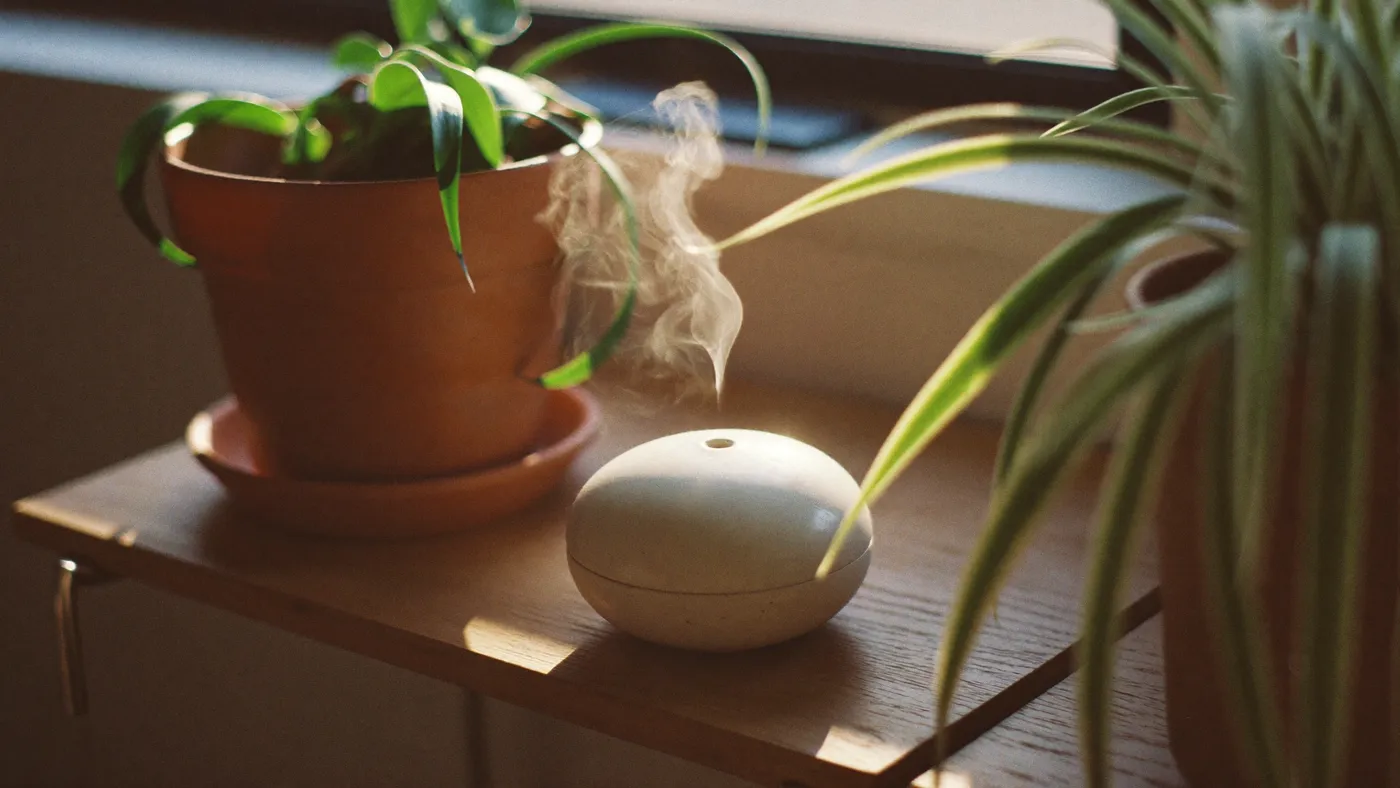
If you want to try it, the common, low-risk methods are inhaling from a diffuser, adding a few drops to a warm bath, or diluting oil in a carrier oil for a personal rollerball you can use at your wrists. Undiluted oil should not go directly on skin. Treat the scent as a small ritual woven into a calmer routine, rather than the whole plan.
Aromatherapy as One Layer of a Calmer Routine
None of this means scent is useless. A pleasant, familiar smell can still be a quick, low-effort cue that a moment of calm is starting, especially when it is paired with something else you already do, like a short reflection or a grounding pause during a stressful afternoon. InnerSmith treats scent this way: as one small, honest layer among several rather than a stand-alone fix. InnerSmith is pre-launch and building its waitlist, and the same approach, many small layers chosen for how your day actually feels, guides how it matches other calming activities too.
Frequently Asked Questions
Do essential oils actually help with stress?
Sometimes, but the effect is smaller and less consistent than most marketing suggests. A standardized oral lavender oil capsule has shown real, replicated benefits for anxiety in clinical trials, while diffused lavender oil has performed no better than a placebo scent in at least one well-controlled study of everyday stress.
Which scents are calming?
Lavender is the most studied calming scent, with chamomile, clary sage, bergamot, sandalwood, and ylang-ylang also commonly used. Scent reaches the brain’s emotional centers through the olfactory nerve, which is why a familiar smell can shift mood quickly, even without strong evidence behind any single oil.
How do you use aromatherapy for anxiety?
The most common low-risk methods are a diffuser, a few drops in a warm bath, or oil diluted in a carrier oil for a personal rollerball. Cleveland Clinic notes aromatherapy tends to help more with short-term, situational anxiety than with ongoing chronic stress.
Are essential oils safe to use every day?
Most people tolerate diffused or properly diluted essential oils well, though the NCCIH notes possible skin reactions topically and stomach upset if taken orally. Oils can interact with sedatives, and safety in pregnancy is not well established, so check with a doctor if you are unsure.
Can InnerSmith help me build a calming scent habit?
InnerSmith treats scent as one small, optional layer alongside other grounding habits, matched to how your day feels rather than prescribed as a fix. It is currently pre-launch and building its waitlist.
Sources
- Lavender: Usefulness and Safety, NCCIH, National Institutes of Health, 2025.
- Aromatherapy, NCCIH, National Institutes of Health, 2020.
- Evaluation of Aromatherapy With Lavender Oil on Academic Stress: A Randomized Placebo Controlled Clinical Trial, Contemporary Clinical Trials Communications (NIH PMC), 2019.
- Silexan in Anxiety, Depression, and Related Disorders: Pharmacological Background and Clinical Data, NIH PMC, 2024.
- Can Aromatherapy With Essential Oils Provide Stress Relief?, Cleveland Clinic, 2024.
- Aromatherapy, Cleveland Clinic, 2023.
Keep reading
All Stress Management →
Catastrophizing: How to Stop Worst-Case Thinking
Your brain is not broken. It is running a very old survival program in a world that changed much faster than the wiring did, and there are real, research-backed ways to interrupt the spiral.
7 min read

How to Reduce Stress at Work: Start With Real Rest
Working longer rarely fixes exhaustion. It usually deepens it, and this is what happens when you trade a few hours of hustle for real, deliberate rest.
8 min read

Emotional Overwhelm: When Their Feelings Flood You
Feeling everyone else's emotions before your own is exhausting in a way that is hard to name. Here is what is actually happening in your body, and where to start changing it.
9 min read